Kenya Records 2.7 Billion Cyber Threats in 3 Months. Should You Be Worried?
Kenya detected 2.7 billion cyber threat events in three months. Understand the figures, the risks to your accounts, and practical ways to stay safer online.

The short version
Kenya detected about 2.7 billion cyber threat events between July and September 2026, up 14.45 percent from the previous quarter. The total does not tell us how many attacks succeeded. Password guessing grew fastest, making unique passwords and stronger login protection sensible precautions, alongside watching for scams.
About 29 million detected events a day is enough to make anyone look suspiciously at their phone. That is the daily average behind Kenya's latest cybersecurity figures, but before you delete your banking app, it helps to understand what is being counted.
The Communications Authority of Kenya's National KE-CIRT/CC recorded the activity over three months. Its report offers useful clues about the pressure on digital services, without establishing your personal chances of being hacked.
What the Numbers Actually Say
The exact total is 2,696,335,021 detected threat events. System attacks accounted for 2,552,948,966, roughly 95 percent, mostly in the network attack subcategory. Malware reached about 70.8 million events, brute force about 44.9 million, and web application attacks about 27.4 million.
Those categories describe activity observed by the monitoring team. They cannot be treated as counts of individual victims, separate criminals or confirmed breaches. The report discusses successful compromises in places, but gives no total of successful attacks and no overall success rate.
Automated tools can generate repeated attempts, so a very large event count does not translate neatly into the number of people affected. Equally, detection alone does not prove an attempt was blocked.
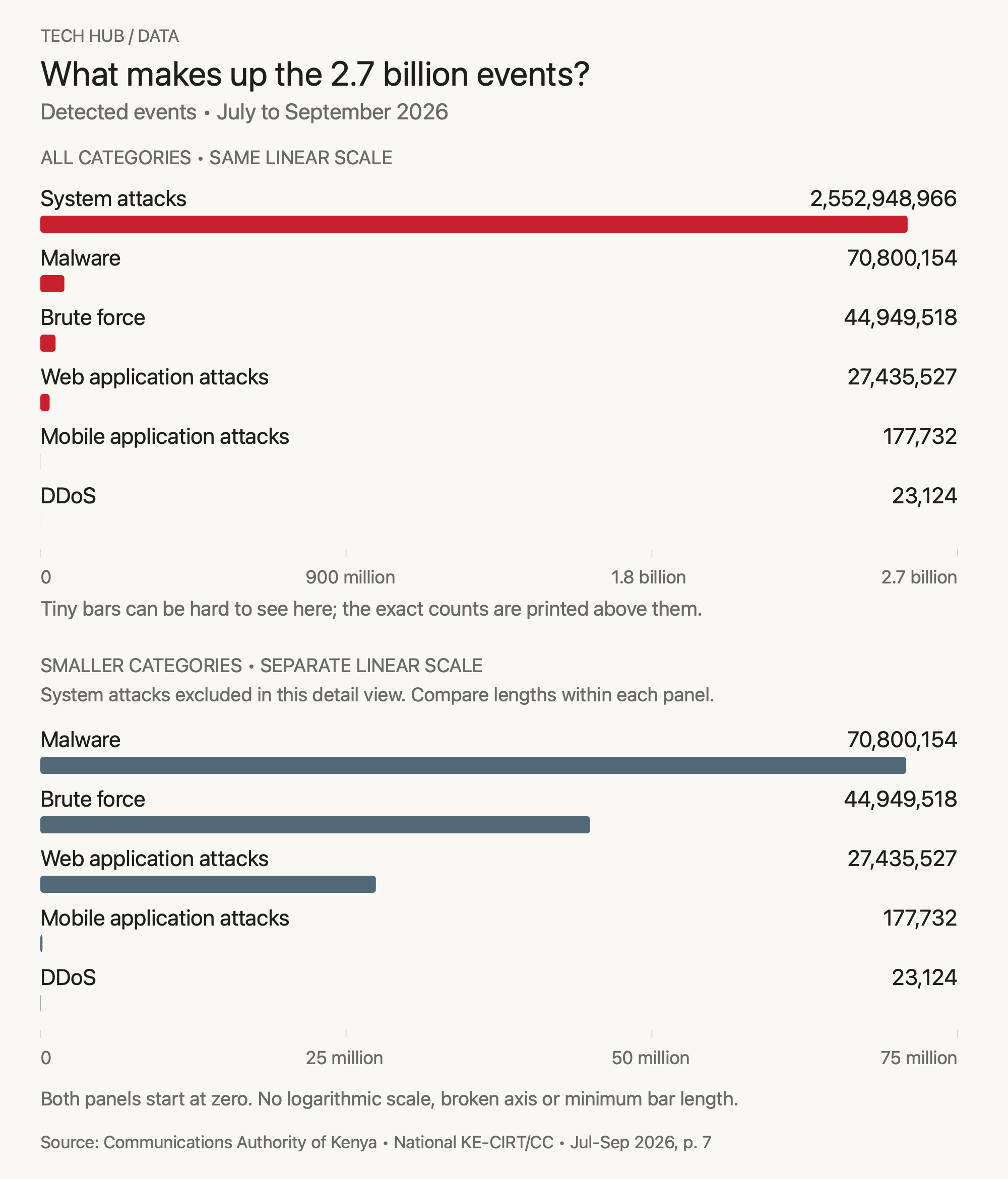
Detected events by category, July to September 2026. The top panel uses a shared scale starting at zero, so bar lengths show relative counts accurately. The lower panel shows the smaller categories on a separate scale. Source: Communications Authority of Kenya, National KE-CIRT/CC, p. 7.
Your Phone, Your Money, Your Data
If you use your phone for M-Pesa, banking, email and WhatsApp, the concern is easy to understand: a small device holds access to a surprisingly large part of your life.
The report identifies banks and cryptocurrency platforms among malware targets. It does not name M-Pesa or provide a platform-by-platform breakdown, so these figures cannot tell us how many events involved mobile money.
Mobile application attack attempts actually fell 3.08 percent to 177,732. That is a change in one monitored category, rather than a verdict on whether your own phone is safer. Protecting the device and protecting the accounts you use on it remain separate jobs.
Scammers Have New Tricks Up Their Sleeves
Phishing is the familiar trick of impersonating someone trustworthy to persuade you to reveal information, open something harmful or send money. The report warns that AI can help criminals produce more convincing communications, although it does not measure how much AI contributed to the quarterly rise.
Imagine a text saying your bank account will be suspended unless you follow a link. Polished English or a familiar logo would give you little reason to trust it. Canada's Cyber Centre warns that AI makes clues such as poor spelling harder to rely on.
For online scams in Kenya, the useful question is what the sender wants you to do. When a message demands money, a code or an urgent login, open the official app yourself or call a number you already know is genuine.
The Password Problem We Keep Ignoring
Brute force attempts rose 85.41 percent, the fastest increase among the six categories. Think of software trying keys on a huge ring, checking login combinations until one works. The speed depends on the system and its safeguards, so there is no single rate that applies to every account.
Reusing passwords creates another opening: credentials stolen from one service can be tried elsewhere. A password manager helps you keep a different, long password for each account without memorising the lot. Companies also need controls that limit repeated login attempts; customers cannot fix those from their phones.
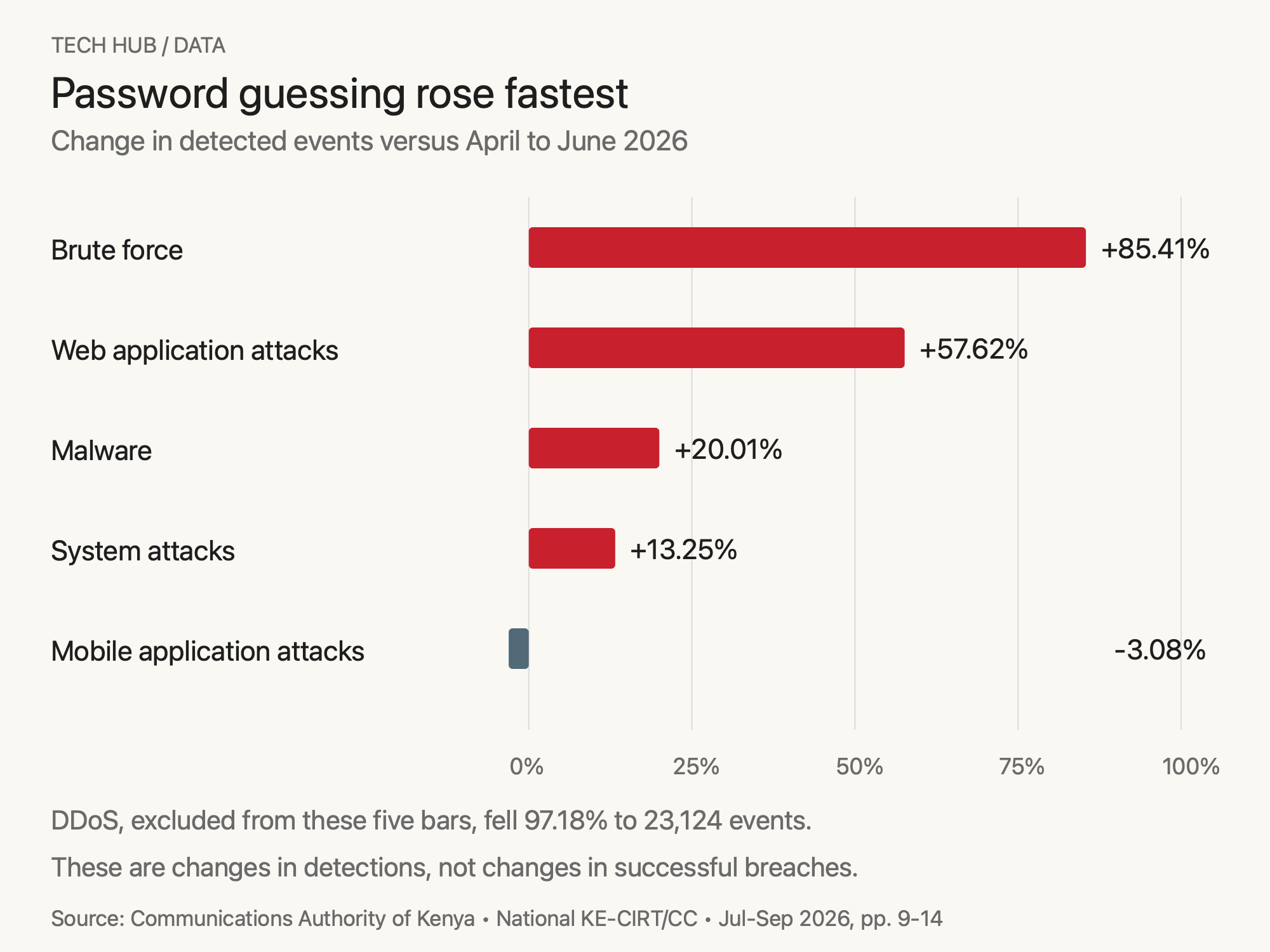
Quarterly change versus April to June 2026. DDoS fell 97.18 percent to 23,124 events and is noted separately. Source: Communications Authority of Kenya, National KE-CIRT/CC, pp. 9 to 14.
So, What Can You Actually Do?
Start with the accounts you would least want to lose, especially your email. These habits are practical even if you never read another cybersecurity report:
Use long, unique passwords, stored in a trusted password manager. Change any password you have reused on an account that was compromised.
Enable two-step verification on WhatsApp, and multi-factor authentication on email and banking services where offered. Prefer a passkey or security key where supported; ordinary verification codes can still be phished.
Keep PINs and one-time codes private, and reject login approval requests you did not initiate.
Install apps from trusted stores, check the developer and permissions, and avoid unnecessary access to messages or contacts.
Keep your phone, apps and router updated, with automatic updates enabled where practical.
Should Kenyans Be Worried?
Concerned enough to tighten a few habits, yes. The headline alone cannot tell you whether your account is in danger, and a rise in detections is not a measured rise in successful breaches.
Cybersecurity in Kenya also depends on the organisations running essential services. Stronger passwords help with account access; secure software, timely updates and well-managed systems address risks that consumers cannot control. Take the figures as a reason to check your protections, while expecting banks, businesses and government to do their part.
Sources: Communications Authority of Kenya, National KE-CIRT/CC Cybersecurity Report, 43rd edition, July to September 2026; Canadian Centre for Cyber Security, phishing guidance; FBI, online safety guidance; OWASP, brute force protection; WhatsApp, two-step verification; CISA and FBI, phishing-resistant authentication.