iPhone Duo Review: Is Apple's First Foldable Worth It?
We read the major iPhone Duo reviews. See how the crease, cameras, battery and $1,999 price add up, and whether you should buy it now, wait or skip it.
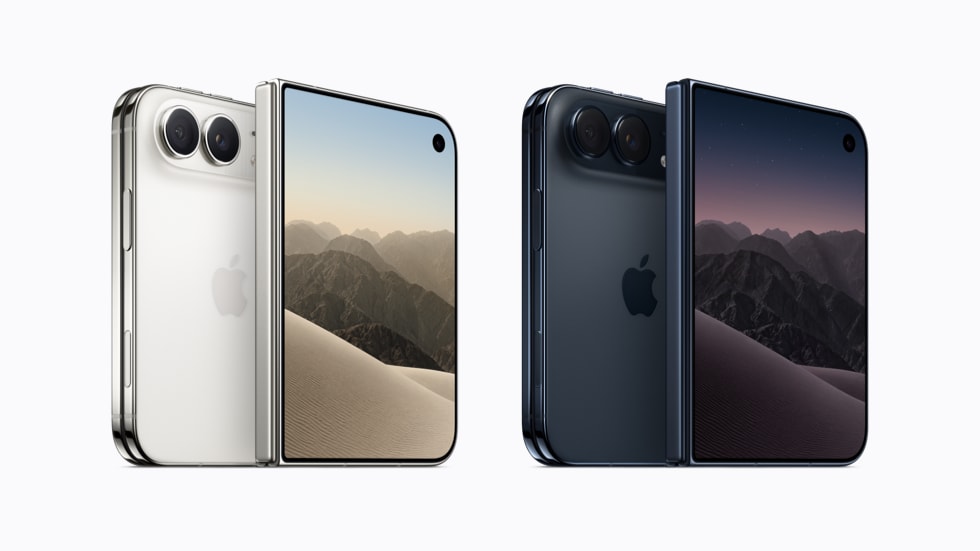
Apple spent years watching other companies fold their phones, then turned up with a passport-shaped one that starts at $1,999. The iPhone Duo went on sale on 23 October, and the first round of reviews is in. They are warmer than you might expect for a first-generation product, and more divided than the scores suggest.
We haven't tested the Duo ourselves. What follows pulls together what the major reviewers found, explains where and why they disagree, and adds our own read on who should spend the money.
The Short Version
Reviewers broadly call it the best-designed foldable yet. The crease is hard to spot and the hinge feels excellent.
Performance matches the iPhone 18 Pro. The cameras are good, but there is no telephoto lens and no Face ID.
Software is the weak spot, because many apps have not been adapted for the bigger screen.
Buy it if you want a foldable and can live with early-adopter pricing. Wait if you hoped it would replace a Pro iPhone.
A Crease You Have to Go Looking For
Open the Duo and you get a 7.6 inch screen in a wide, book-like shape, closer to a small tablet than the tall, narrow foldables we have seen before. The outer screen measures 5.4 inches, so the phone is usable closed. Apple covered the inner display with a matte nano-texture layer, and reviewers broadly agree it hides the crease remarkably well. In an early hands-on, some reviewers called it the closest to invisible they have seen.
The hinge gets the warmest praise. MKBHD says it holds half open better than any foldable he has used. The Duo is also rated IP68 for dust and water, where Samsung's Galaxy Z Fold 8 is IP48.
The matte finish has a price. Tom's Guide and Engadget both found colors a little muted in bright rooms, even though glare is reduced. And it is a heavy phone. It is about 254g, more than 25% heavier than the Fold 8.
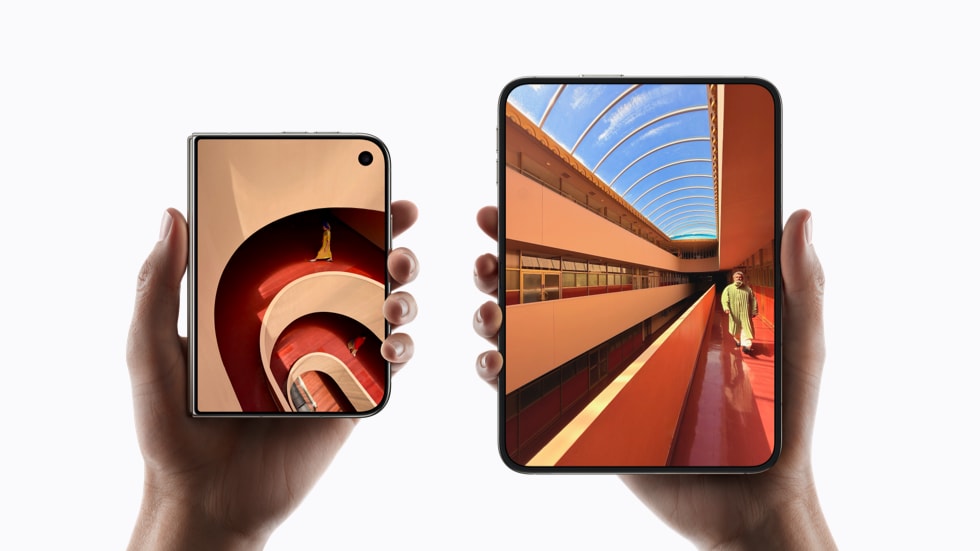
Two Screens, One Awkward Dock
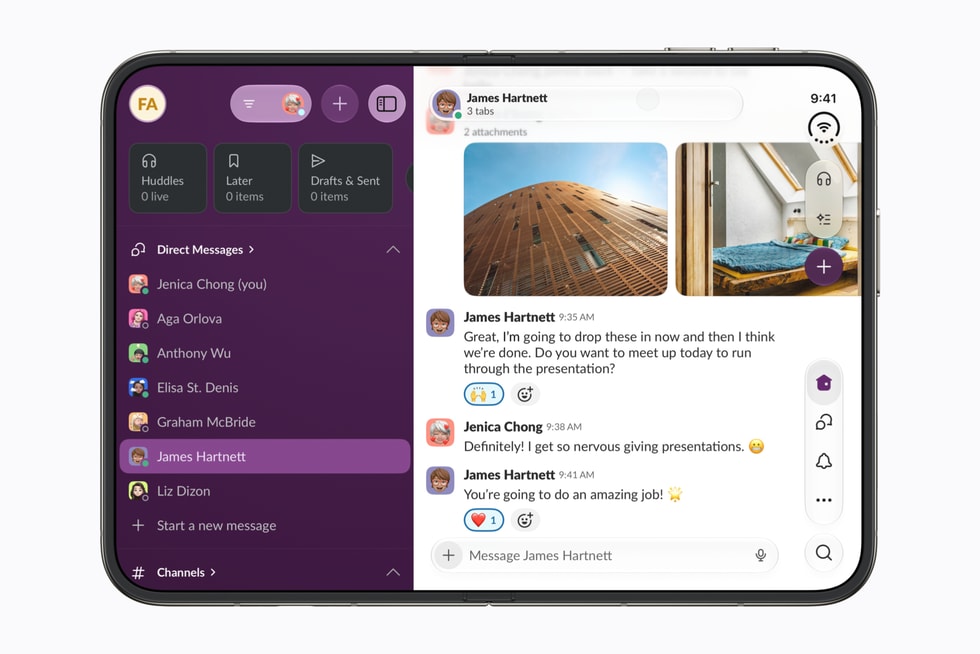
The Duo runs iOS 27.1, which moves the dock to the right edge on the big screen. It also adds Split View, though only for two apps at a time. Apple says Apple Pencil support will arrive later this year.
The dock is where opinions split. The cover screen gives up too much space to it, while some reviews do not find the outer display cramped. Our guess is that it comes down to how much you type on the outer screen.
The bigger issue is apps. There are plenty of wasted space in apps that have not been updated, and users have to wait a few months for developers to catch up. We expect the major apps to adapt in about six months. That is a forecast, not a promise.
Raw speed is not a worry. The A20 Pro chip matches the iPhone 18 Pro, and testing have shown near-identical benchmark scores with no visible throttling. The Verge did report some heat and lag during long camera sessions, so it is not flawless.
The Cameras: Something Had to Give
The Duo has two 48MP cameras, a main and an ultrawide, and no telephoto. Apple's 2x zoom is a crop of the main sensor, which reviewers describe as optical-quality rather than truly optical. The zoom falls apart somewhere between 8x and 10x, and photos trail the iPhone 18 Pro in low light.
Photographer Tyler Stalman called the dual 48MP setup solid but missed a dedicated zoom, plus ProRes and Log video. The camera inside the phone fares worse. MKBHD called the hidden under-display selfie camera 'bad', so use the outer 12MP one for selfies and video calls.

Battery Life: Can It Survive a Busy Day?
Apple claims up to 31 hours of video on the inner screen. Independent numbers are lower and vary with the test. Tom's Guide measured 13 hours 20 minutes in its web-browsing test, ahead of the Fold 8 at 10 hours 6 minutes. Engadget ran a video loop and got 28 hours 48 minutes, against 28 hours 14 minutes for the Fold 8, and says it typically had 40% or more left at the end of the day.
So it should last a normal day, and whether it beats the Fold 8 depends on which test you trust. Apple says a 60W adapter gets you to about 50% in 20 minutes, but the adapter is sold separately and the box holds only a USB-C cable.
Touch ID, Weight and the Hinge Question
There is no Face ID. Unlocking happens through Touch ID in the side button, or through an Apple Watch. It is slightly slower than Face ID, which is a small annoyance rather than a dealbreaker.
Durability is the open question. MacRumors has reported forum photos of screens failing along the hinge. One Australian owner says it happened after fewer than 20 opens, and Apple replaced the unit. Some photos come from demo units in China with unknown histories, the scale is unclear, and Apple had not commented in that report.
Other evidence points the other way. A robot fold test of 32,640 folds found no problems, although a lab test found the crease slowly deepens with use. Apple has so far not published any fold rating. If the outer layer of the screen does get damaged, Apple lists a $49 replacement fee, or $19 with AppleCare+.
The Price Tag Has Entered the Chat
The Duo starts at $1,999 for 256GB. The 512GB model is $2,199, 1TB is $2,599 and 2TB is $3,199. Nobody is calling that cheap. Reviewers who judged it against the Galaxy Z Fold 8 liked it, while those who asked whether it should replace a Pro iPhone mostly said to wait. That difference in question explains most of the split in verdicts.
Buying It Outside the Launch Countries
Apple has not named some outside countries like Kenya among its launch markets, nor said which countries get the phone on 30 October. A Kenyan retailer listing shows KES 299,999 for the 256GB, but since it is out of stock and we could not confirm it. The same goes for any market Apple has skipped: check import duties, whether your carrier supports eSIM (the Duo has no physical SIM slot) and whether Apple's warranty covers a phone bought in another country, since it can be restricted to the country of purchase.
So, Should You Buy It?
Buy it now if you already use an iPhone, want a foldable, and have money you are happy to spend on a first-generation product. Reviewers rate the hinge and the hidden crease among the best they have seen, and the IP68 rating beats the Fold 8's.
Wait if you rely on a telephoto lens, want Face ID, or worry about the hinge reports. Waiting also lets app developers catch up and gives the durability picture time to clear.
Skip it if you simply want the best iPhone. A Pro iPhone has the telephoto lens and Face ID the Duo lacks, and the reviewers who asked that question mostly found the compromises hard to justify at this price.